My Cordoba

In the 1970’s actor Ricardo Montalban was not only famous for staring in the TV series “Fantasy Island” but also as Chrysler’s celebrity spokesperson for marketing the Cordoba automobile. Who can ever forget his rich voice saying “soft Corinthian leather” when describing the car’s interior? Cordoba was “my car” although I never owned one. I did have high expectations for my explorations of Cordoba, Spain, linked by name although it is uncertain if Chrysler intended it to be so. Huge by today’s standards, in the ’70’s the Cordoba automobile was actually a “junior size” Chrysler! My excursion, however, was not a junior size at all; it was huge as I experienced another aspect of the culturally rich country of Spain.
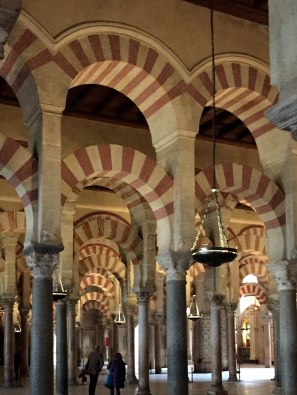
FullSizeRender (11)
Interior of the Grand Mosque

Through the ages Cordoba has been everything from a small Roman outpost to the seat of power during the periods of Muslim occupation. Evidence has been found of humans in the area between 42,000 and 35,000 BC! An interesting fact is that Cordoba is believed to have been the most populous city in the world in the 10th century! Today, Cordoba is a small modern metropolis of about 300,000 and is protective of its Roman, Muslim, Jewish, and Christian heritage. That heritage loudly screams throughout the city, particularly in the area surrounding its famous UNESCO World Heritage Site mezquita (mosque) landmark as well as the Roman Bridge dating from the first century!

The city has witnessed numerous changes through the centuries which were driven by religious-based conflicts involving Christians and Muslims. In 1236 King Ferdinand III secured the city during the Spanish Reconquista. Since then numerous mosques were converted to churches including the huge one where the sanctuary was created in the middle of the existing mosque. The Christian era also brought about a dark period of the Spanish Inquisition with Cordoba at the epicenter. During this period non-Christians were treated as second class citizens with Jews and Muslims often forced to renounce their faith, leave, or die.
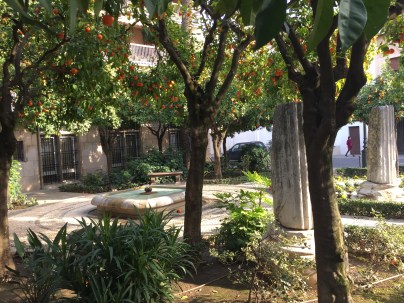
IMG_3824
Peaceful Park in Cordoba

Walking through the narrow ancient streets one can celebrate the heritage where today Christians, Jews and Muslims live together in peace among the past Roman remnants of a beautiful city.

There are numerous parks throughout Cordoba like the one pictured that are quiet where you can pause, reflect and enjoy the simple sounds of water bubbling in the fountain. As in the pictured park, ancient pillars stand reminiscent of Roman times. Other parks are significantly larger and city planners appear to have gone to great lengths to incorporate them among the very wide avenues surrounding the ancient city walls.
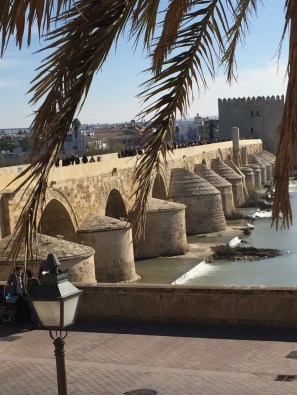
FullSizeRender (12)
Roman Bridge

Most of my time during my exploration of Cordoba was inside the old city walls and remnants of them. Outdoor cafes are plentiful on the cobblestone streets among ancient buildings created mostly in the last 500 years. I was in awe walking across the preserved Roman Bridge and the cathedral where the bell tower stands among the orange trees and was constructed surrounding the original minaret.

I found the food and drink to be different from other places I have visited in Spain. There was often a blend of creations that reflected the cultures that I mentioned previously. I didn’t care for the local wine and found the famous cold, thick, tomato-based salmocejo soup to not be to my taste either. Regardless, there are plenty of different foods and drinks that more than provided very enjoyable sustenance!
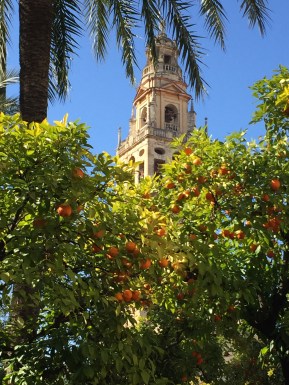
IMG_3798
Cathedral Bell Tower

Just like the Cordoba automobile of my youth, the city of Cordoba in Spain holds a special charm… one which is much longer lasting.

Cordoba is a beautiful modern city surrounding an old city with an outstanding Roman, Christian, Jewish and Muslim heritage. It is easy to see why this ancient place is preserved as a World Heritage Site for us and future generations to enjoy.
My Ancestor, the Witch

My blog is almost always about my exploration discoveries from travels following my retirement. Most of the time I record my observations and experiences but sometimes my exploration adventures come from things I research. In this blog I am recording information about an exploration I have undertaken over several years which resulted in discovering a witch in my family tree.

salem-witch-trial_large
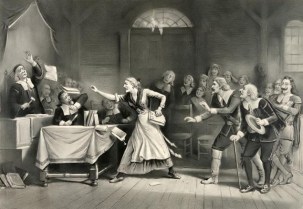
A Depiction from a Salem Witch Trial

A few years ago I visited Salem, Massachusetts where in 1692-1693 trials were held for several people accused of being witches. The trials resulted in the executions of twenty people, most of them women. This historic place in the early days of European settlement in America was important to me as I stood at the very place where these people were “tried.” One  of those tried in the witch trials, Ann Alcock Foster, is my 11th great grandmother.

The witch hunt of this period is greatly studied and speculation surrounds this dark time in history when people could be accused, tried, convicted, tortured, and put to death based on speculation, false accusation, hearsay, coercion, and whispers.

I learned about Ann Alcock’s story from my ancestry research. There are many interesting stories in my family tree involving several American Revolution patriots, people burnt at-the-stake, American Civil War soldiers on both sides, and people from all over Europe. Ann Alcock’s story is quite interesting and well documented.

In 1692, Joseph Ballard’s wife, Elizabeth, came down with a fever that confounded her doctors. Witchcraft was suspected and a search for the responsible witch began. Two afflicted girls of Salem, Ann Putnam and Mary Walcott, were taken to Andover to seek out the witch and, at the sight of Ann Alcock Foster, the girls “fell into fits,” and Ann, 72, was subsequently arrested and taken to Salem prison.

At her witch trials Ann Alcock initially resisted confessing to the “crimes” she was accused of having committed, despite being put to the question (i.e., tortured) multiple times over several days. But when her daughter Mary Lacey, also accused as a witch, accused her own mother of the crime in order to save herself and her child, Alcock confessed that she rode on a stick with Martha Carrier, a previously convicted witch, to Salem village, that the stick broke and she saved herself by clinging around Martha Carrier’s neck. She said they met three hundred witches at Salem village.

The “examinations” at the trials of Ann Alcock Foster are documented in the Boston Public Library, Department of Rare Books and Manuscripts, and are quoted as written. “The Examination and Confession of Ann Foster at Salem Vilage 15 July 1692 after a while Ann foster confessed that the divill apered to her in the shape of abird at several Times, such abird as she never saw the like before, & that she had had this gift (viz of striking the aflicted downe w’th her eye ever) since, & being ask’t why she thought that bird was the divill she answred because he came white and vanished away black & that the divill told her that she should have this gift & that she must beleive him & told her she should have prosperity & #[that] she said that he had apeared to her three times & was always as a bird & the last time was about halfe a year since, & sat upon atable had two legs & great eyes & that it was the second time of his apearance that he promised her prosperity & that it was Cariers wife about three weeks agoe that came & perswaded her to hurt these people. 16. July. 1692. Ann Foster Examined conffesed that it was Goody Carier that made her a witch that she came to her in person about Six yeares agoe & told her if she would not be awitch the divill should tare her in peices and Cary her away at w’ch. time she promised to Serve the divill, that she had bewitched a hog of John Lovjoyes to Death & that she had hurt Some persons in Salem Vilage that goody Carier came to her & would have her bewitch two children of Andrew Allins & that she had then two popets made and stuck pins in them to bewitch the said Children by which one of them dyed.”

Alcock Grave
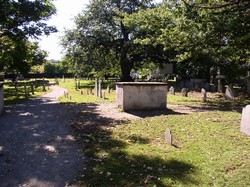
Ann Alcock Foster Grave

Convicted, Ann died in jail in the winter of 1693, before the trials were discredited and ended. In total, when the witch hunt ended, nineteen had been executed and at least four (including Alcock) had died in prison from exposure and disease in bad living conditions. One man had been pressed to death. About one to two hundred other persons were arrested and imprisoned on witchcraft charges. Two dogs were executed as suspected accomplices of the witches. The Salem witch trials continue to be studied for their social and judicial implications. They are an interesting, sad part of America’s history and my family heritage.