I am fascinated when people incorporate legends and mythology into culture. I know it happens all the time and the myth becomes “normal” and is accepted without further contemplation of it. So it is in Zagreb, Croatia, with fierce dragons. In Zagreb there exists a fixation with these mythological flying, flame blowing monsters!
Dragons have always been popular with children. With adults they are very popular today throughout the world where people watch the TV series Game of Thrones. Last month I lived in and explored Zagreb and learned about their dragons and observed how they are incorporated into the residents’ lives. This is my story about my adventure with the dragons of Zagreb!
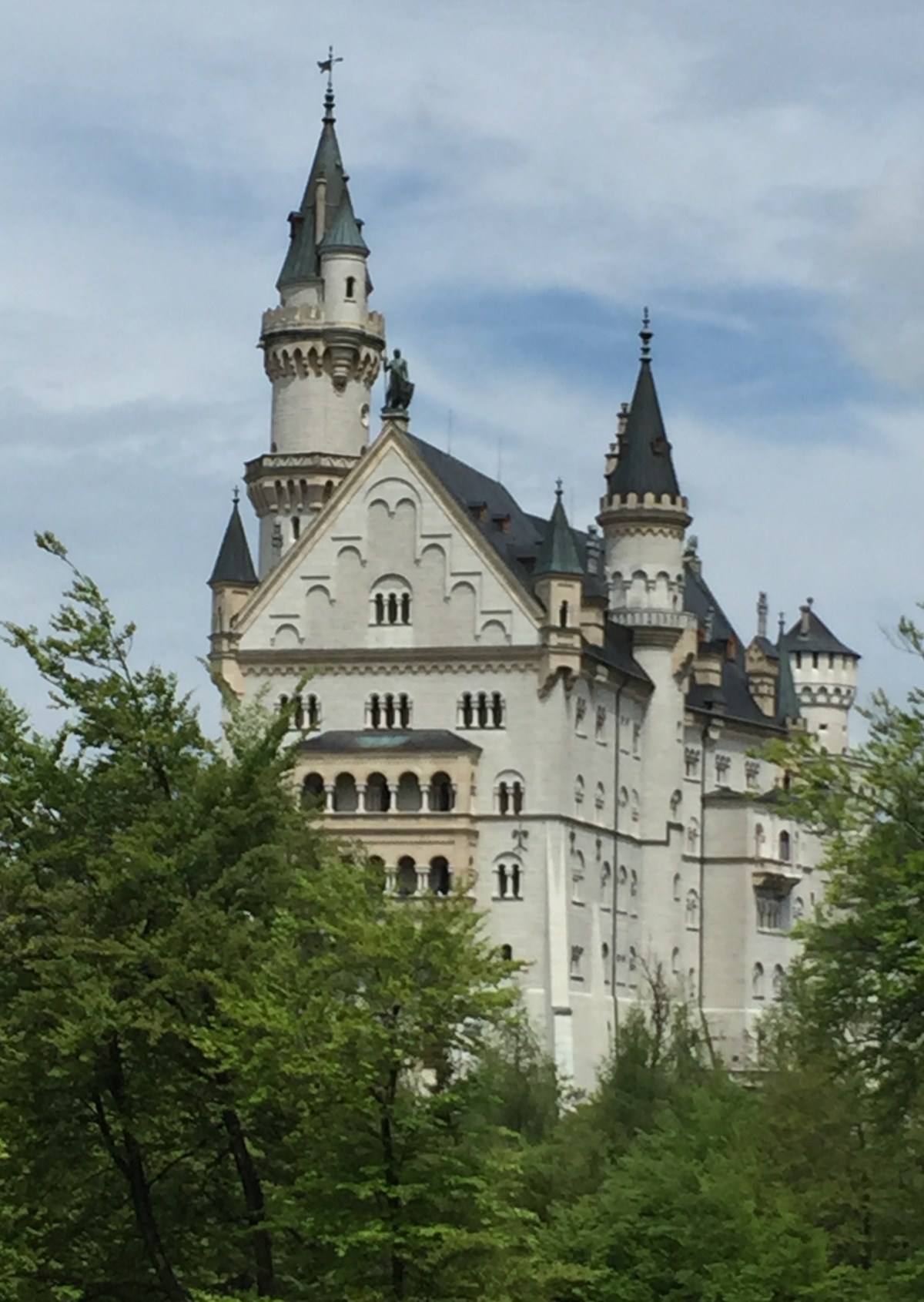
Perched in the Bavarian Alps, a short train ride from Munich, is the famous Neuschwanstein Castle. Known as the inspiration for Disney’s Cinderella Castle, the unfinished Neuschwanstein is the fairytale passion of King Ludwig II of Bavaria. Among his accomplishments as monarch, Ludwig is remembered for building castles. They were so lavish and costly, he brought his family fortune to its knees and construction had to stop, leaving two of the castles unfinished.
Last month on my exploration in Bavaria I visited two of Ludwig’s castles… Neuschwanstein, the fairytale castle, and Herrenchiemsee, the Bavarian copy of Versailles. I have learned a great deal about Ludwig’s life. In each castle you can sense his eccentricities and his passion for the grand and spectacular. There is much more to his story and in this blog I tell stories about the castles and recall the intrigue of his life and death.Continue reading “Eccentric Bavarian King Ludwig II”
I have now been in Cluj-Napoca, Romania for almost a month and I have made many observations while exploring this small city. This entry into my travel blog is about my observations during my exploration of Cluj.
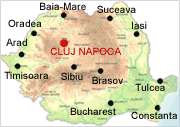
Cluj is located in the north central Transylvania region of Romania. It has a very long history influenced by Romans, Hungarians, Gypsies, Transylvanian German Saxons, Communists and several religious affiliations.
Mihai Viteazul Memorial
Cluj is a livable city of about 330,000 people. Much of the population is composed of college students from the 6 universities in the city. I like it here and have decided to return during June and July to further explore Romania in general and Transylvania in specific.
Mihai Viteazul is remembered as a Romanian hero with memorials to him in Cluj, Bucharest and elsewhere in the country. Known as “Michael the Brave,” he was the Prince of Wallachia, of Transylvania, and of Moldavia. He united the three principalities under a single rule which eventually became modern-day Romania.
Through the centuries there has been so much historic interaction between the Romanians and people from the Ottoman and Austro-Hungarian Empires, Germans, and others. To recount history would make my head hurt so I won’t. That said, the area in and around Cluj has a huge history and there are many remnants as reminders of the past.
For those so inclined, Cluj presents an exceptional place for historic research and learning. In this blog, however, I am going to emphasize more about my thoughts and observations with some historic notes interspersed.
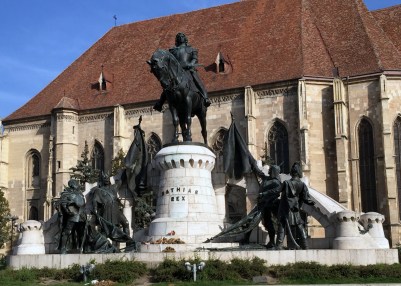
Matthias Corvinus, King of Hungary, was born in Cluj and is remembered in Unirii Square
I arrived in Cluj by train from Budapest in early April. The 7 hour train trip was delayed arriving by 3 hours but once I was settled, my exploration of the city began at its ancient heart, Unirii Square. In and around the square are important Roman artifacts from the 1st century and newer structures.
The newer points of interest include the imposing Saint Michael’s Catholic Church dating back to the 14th century and the massive memorial to Matthias Corvinus, a former King of Hungary and Croatia born in Cluj, Romania in 1443. Banffy Palace from the 18th century is home of the National Art Museum and was the palace for the Governor of Transylvania. It is located opposite St.Michael’s Church and a block away is Corvinus’ birthplace from the 15th century in the center of the medieval historic museum area where numerous street vendors and outdoor cafes are located.
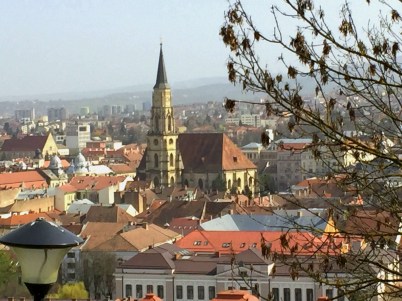
From Cetatuia Hill, St. Michael’s Catholic Church dominates the Cluj skyline
The city is bursting with memorials. Preserved old city walls and remnants of earlier protective fortifications are found nearby. There are many memorials to historic and noteworthy individuals throughout the Central Park. And the architectures of the Dormition of the Theotokos Orthodox Cathedraland the adjacent Romanian National Opera Houseare beautiful. From a vantage point on Cetatuia Hill (once the location of a fortress) overlooking the city, St. Michael’s dominates the city skyline. Just outside Central Park is a monument that is dedicated to the resistance to the Communists and those who died in Cluj during the violent December 1989 revolt that ended the Romanian Communist government.
Historic Orthodox Church
Romanian National Opera
There are several museums and an attractive Botanical Garden in Cluj. These along with the places I have previously mentioned attract numerous visitors mainly from Eastern and Central Europe. Theater, opera, symphony, and cultural events are highlights within the city. There are many small cafes, hidden bistros and aromatic pastry shops that provide traditional, very flavorful Romanian and international foods and drinks.
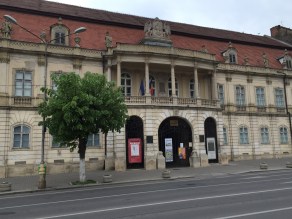
Banffy Palace
Services to sustain the infrastructure appear to be a challenge to the city authorities. Basics such as utilities and transportation are provided well. Although it is interesting to walk back in time in the city among old structures and memorials, the buildings that look good are maintained by private investments. It is sad to see deterioration of the public buildings such as the historic Banffy Palace which is literally crumbling. Many of the residents see this as a difficult reality where spending decisions have been made to allocate revenue among many competing priorities.
Under the prior Communist regime people recall long queues for small amounts of meat and bread. One person told me that it was special at Christmas to be able to get his only orange for the year. Life today, although difficult, is better. Life outside the city is very much at a subsistence level and I will discuss that in a future blog. The massive ugly housing projects during the Communist era remain as a stark reminder of that sad time.
Almost everyone I have met is pleasant and speaks English… and often a third language in addition to Romanian. Everyone has stories that they are happy to share about themselves, their country, its history, and the world. The people are often highly educated with post-graduate degrees but many times find themselves doing service related work or jobs with lower skill requirements. Pay is low for all positions. Many Romanians go to other European countries to work in construction and agriculture. Buying fresh flowers from street vendors or the market is really big in Cluj. Everyday there are beautiful floral displaces in many places.
Cluj is a very nice Eastern European city. I like it and the surrounding area and will blog more over the next few months about my observations from my explorations throughout Romania. If you have comments, please let me know in the space provided below.
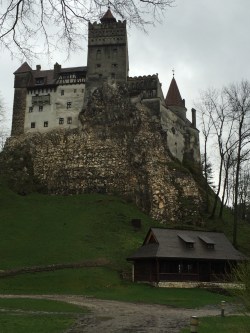
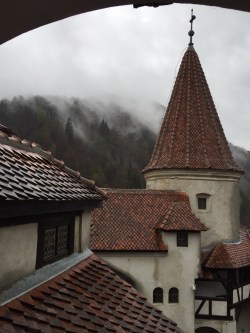
Dark legend surrounds “Count Dracula” and his vampire wives as living in their Transylvania castle. Nourished by blood that they suck from their victims at night, these vampires are rumored to live an otherwise solitude life in the Carpathian Mountains. With wisps of clouds hanging low in the deep forest, I ventured to Bran Castle in Romania. The castle is otherwise known as “Dracula’s Castle.” This blog is about my latest exploration to learn more of this character made famous by Bram Stoker in his book and by Bela Lugosi, the actor in the 1931 Dracula movie. A light drizzle on a cold, gloomy, dismal April day set the mood to visit such a place shrouded in mystery.
Eerie clouds from an inside the castle vantage point
Standing outside the castle entrance I observed a young Orthodox Christian couple taking a selfie and then blessing themselves prior to ascending the slippery, uneven stone steps to the open castle door.
I didn’t bring any garlic or wolfsbane with me but my traditional Romanian pork stew lunch was so loaded with garlic that I thought that only a breath directed toward any vampire would overpower and easily repel them. As I walked into the castle’s entry room, I noted the locked basement door were it was logical that vampires would be “resting” during daylight in their native soil. I saw no bats and heard no wolves; I saw no red eyes staring at me from the shadows. As legend has it, vampires cast no image in a mirror so I remained vigilant to look for mirrors but I found none.
The small castle has all the mystery one might expect to lend credibility to Bram Stoker’s creation. In reality, Dracula is based somewhat on Vlad III, “The Impaler,” Prince of Wallachia, who I will discuss a bit later. Stoker in his genius drew from tales he heard of the castle (that he didn’t visit) and other legends from Eastern and Central Europe. It is amazing how authors and screen writers can paint images in our minds so we escape into an artificial reality… and Stoker was quite capable of doing so with Dracula.
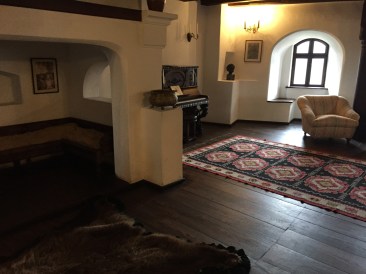
Castle Living Room
Constructed atop a huge rock, this small but imposing structure is a large interesting house with many rooms containing numerous artifacts of medieval furniture, carpets and utensils. The interior is often dark and certainly must be even more mysterious at night with its secret, dimly lit passages between floors, fireplaces, and numerous staircases throughout the building to link the rooms. In the 1931 movie, the castle entrance and cob-webbed rooms are larger than the actual castle. However, the castle in Bran provides exceptional inspiration for one’s imagination. And in this house there are other things that one doesn’t find in one’s house today.
Among the things to see in addition to the medieval furnishings are medieval clothes, suits of armor, ancient weapons, shields, items for torture and execution. The castle is very artfully decorated and I must say that the exhibits for torture and execution were the most compelling I have seen. The cruel inhumanity and ingenuity for inflicting pain and death from simple objects is amazing. I felt ill seeing them. And that’s where Vlad comes in; he is known as “The Impaler.”
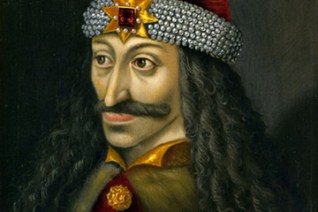
This portrait of Vlad III, painted in the early 16th century, hangs in the museum at Castle Ambras in Innsbruck, Austria. Credit: Public domain
Count Dracula might be a fictional character who emotes fear from the scenes painted in imagery by Stoker and the movie by Lugosi. However, Vlad III, was known in his time as Dracula (Drăculea, in old Romanian). He was real and, in a sense, blood thirsty medieval prince. Known as “The Impaler,” Vlad would have been a terrorist tried on crimes against humanity for his brutally for the ways he punished his enemies. You can read more about his life and his brutality elsewhere on the Internet.
One of Vlad’s infamous ways of execution was to impale the person by driving a large wood stake about 2 1/2 inches in diameter up through the person’s torso along the spine, through the neck and out their mouth. If the procedure didn’t kill them, they likely would last only a short time until they did. Vlad was known for having mass impalements and reportedly washing his hands in the blood of victims before eating his meals among the “forests” of them. These forests of rotting flesh were his design to deter advancing enemies and to warn populations about the consequences of dissension to his rule.
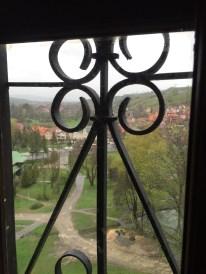
A view looking toward Bran, Romania
This castle known as “Dracula’s” was not where Vlad lived. He was at another one that today is rubble, However, the images for the biting, blood-sucking vampire tales are drawn from imagination based on facts and legends from this mysterious part of Europe that provide interesting and often gruesome stories (of which the Bran Castle is part).
I hope you enjoyed learning more about Dracula, the castle, and Vlad. If you have a reply or comment, please post it above where indicated. If you would like to receive my travel blog in your email, enter your address where provided on the right side of the page.
I recently blogged about my adventure when I participated in “Pueblo Ingles.” I reserved my comments in that blog to my observations about the English immersion program and the students. However, there is more to my story about the nearby medieval Spanish town of La Alberca. This blog entry is about my exploration of that tiny Spanish town and my adventure there.
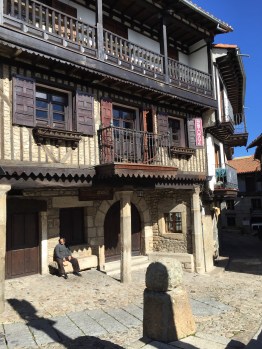
Buildings at Plaza Mayor, La Alberca
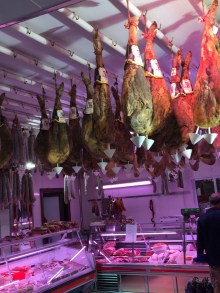
Located at an elevation of 1084 meters, the town with a population of around 1100 is rather isolated in La Sierra de Francia mountains close to the northern border with Portugal. The principle product in this region is delicious Iberian Jamon (ham) which is produced in the area from black Iberian pigs that grow fat eating acorns. This diet gives the ham a very special, enjoyable flavor that is savored by Spaniards as well as those from around the world who are fortunate to experience it. Hams are seen in several shops in La Alberca hanging from the ceilings.
During my explorations of Spain I have visited several Spanish communities and blogged about Cordoba, Granada, Ronda, Canary Islands, and Mijas Pueblo. As I walked the narrow cobblestone streets of La Alberca I was taken aback by the distinctive architecture of this community in comparison to the others I mentioned. While Cordoba and Granada are colorful and reflective of an integration of Moorish design and Mijas is a spectacular white, traditional Spanish pueblo, La Alberca, founded in the 1300’s, is dark and has a somewhat French feel. It is one of the best preserved Spanish towns of the period.
Hams hanging from ceiling
The half timbered buildings surrounding the Plaza Mayor and nearby narrow streets and alleyways are different as their materials come from the quarries and forests of the mountains. The town goes to great lengths to retain its medieval charm.
Knight Templar Symbol
The Knights Templar had a presence in La Alberca. Today there are myths and legends about the “monk soldiers” who participated in the crusades and provided safe passage for pilgrims to the holy land. On the Iberian peninsula they also created a strong trading infrastructure, a banking system, and fought for the Spanish kings in the reconquest of Spain from the Muslims.
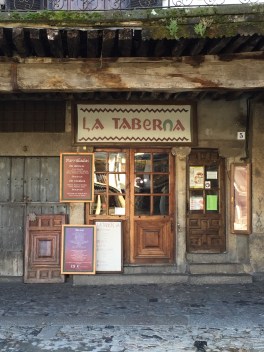
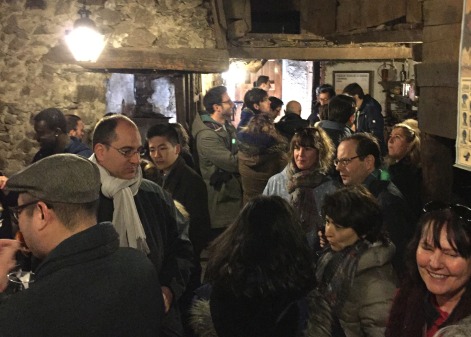
A tavern in La Alberca
The town of La Alberca has a tourist interest as it is preserved in its architecture, food, and customs. For those exploring Spain it is a welcome transition into the Middle Ages from the modern communities of Spain and Portugal.
The next stop in my exploration adventure is Romania where I will be searching for Dracula. Stay tuned!
Although I write my blog for myself, I also recognize that a growing number of people from all over the world are now following it. If you would like to receive my blogs in your email as I post them, please enter your address where indicated on the right side of this page. If you have a reply about my blog, please use the link at the top of this story to let me know.
Last November I read a story in an airline magazine about an English language immersion program held at a resort in Spain. The program, “Pueblo Ingles,” takes place near La Alberca and is offered by Diverbo. The story stated that knowing Spanish wasn’t required for native English-speaking volunteers and that students from Spain were highly motivated to learn. Since I am presently living in Spain, I applied and was pleasantly surprised when I was offered the opportunity to participate in Pueblo Ingles number 1044. Recently, I met my colleagues and attended my first Pueblo Ingles! This post is about my adventure there.
Twenty-two adult students arrived for Pueblo Ingles from all over Spain. Motivated by a desire to learn, they were driven with an intense passion to improve their listening, comprehension, and expression in English. The improvement results that I observed were nothing less than amazing.
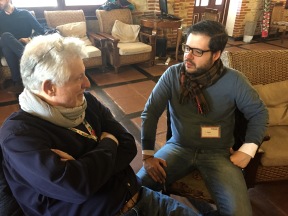
Colin, in his 91st Pueblo Ingles, engages “Quique” in a One to One discussion about “tie up loose ends”
The eight-day Pueblo Ingles required perseverance by the students. It was similar to a “boot camp” facilitated by Diverbo’s superb, energetic on-site staff of two… Sabela and Jez. Every waking hour (often 15 or more) was orchestrated by the Diverbo team. Time was allotted to one to one sessions (between a student and an “Anglo” volunteer), specific subject group discussions, individual presentations, practicing teleconferences, mealtime conversation, theater skits, and evening social activities.
The Pueblo Ingles rule is that everyone is to speak only English during their entire stay. It was almost surreal that the moment that we stepped onto the bus in Madrid for the four hour trip to La Alberca, and until we returned at the end of the program, everyone’s utterances were only in English. Pueblo Ingles quickly became a multicultural experience for both students and volunteers. Not only did the students expanded their English skills at Pueblo Ingles but everyone also learned more about themselves and each other.
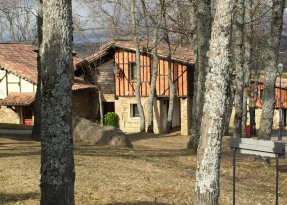
Resort Mountain Villas were shared by a student and an Anglo
The twenty-three English-speaking volunteers came from all over the world. Joining me were native English speakers from several USA states, England, Ireland, Canada, Wales, and Malaysia.
“Anglo” volunteers paid for personal round-trip travel expenses to Madrid from / to “home.” In addition to their travel expenses, students (and sometimes their employers) also paid the Pueblo Ingles program fee.
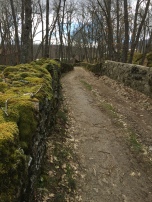
The resort area is very attractive with snow-capped mountains and forests nearby. Walking trails with moss-lined stone walls retain their charm from centuries past. It was easy to envision medieval days with peasants tending to their animals and crops.
Superior Spanish-themed meals were provided at traditional eating times in Spain: 9:00 am, 2:00 pm and 9:00 pm. Pueblo Ingles lodging was in the resort’s rustic villas and almost all activities were held in the lodge and dining facility near them.
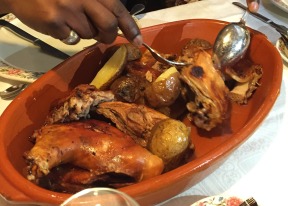
“Suckling pig” and baked potatoes were lunch in La Alberca
From the very beginning students and Anglos met as complete strangers and magic began. Both people listened to each other and communicated in English. The Anglos had the responsibility to ensure that he or she was understood and that the student’s words were correct in both context and pronunciation. It only took minutes and everyone moved beyond talking about their families, jobs and why they were at Pueblo Ingles. People soon were talking about everything… important and irrelevant, global and unique, dreams and fears, etc… Learning began to take place in the interactions between people who a few moments prior to meeting were complete strangers; and learning transcended English into learning about the value we have for each other. This value became visibly apparent with sad “good byes” at the close of our Pueblo Ingles experience.
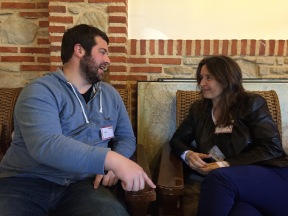
Phil and Fabiola in a One to One session
One to one, 50 minute interactions were at the heart of Pueblo Ingles and every Anglo volunteer was able to interact with each student so the students heard the diversity of the ways English is spoken. The one to one discussions began from a specific phrase or words. The Anglo explained the meaning of phrases such as “wear out,” “wear down,” or “burn the candle at both ends” which have meaning other than the specific words when translated. Soon students began to “think in English” and comprehend rather than translate words and phrases literally. Phrases like “hold your horses” and “paint the town,” which otherwise would have a confusing translation, became meaningful. It was visible when the phrases were understood by the students.
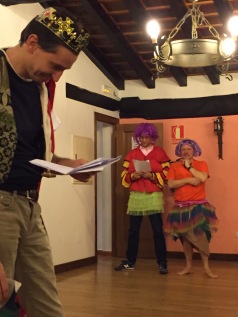
As the prince and two ugly sisters, actors David, Andres, and Tony reenact an abused scene from Cinderella (photo by Dee Wolk)
Phrases such as “break a leg” took on meaning for skits and theater performances by the students and Anglos. Enjoyed by everyone, they provided an entertaining way along with group problem solving activities to learn while acting, playing, and thinking in English. Student presentations will always be remembered each time someone hears something about “Drone Deliveries,” “MOOS” and many more. Each student prepared a presentation for an audience and honed it during several of their one to one sessions. Several Anglos also made presentations including topics such as: “London,” “Mindfulness” and BINGO.
Many students desired to learn how to better equip themselves to participate in teleconferences. I will never forget Azucena, one of the students, in the one in which I participated as a venture capitalist. I was stunned when she proposed (in crystal clear English) to obtain funding to “expand” her fictitious business for “hermetically sealed containers for use in submarines!”
At the end of each day everyone was exhausted from the learning experiences. The participation in the one to ones, discussions, presentations, skits, and conferences was more intense than I thought it would be, especially for the students. I don’t know where the students’ energy came from but the passionate desire to learn and develop was there everyday.
The Students Singing
Queimada
Following the 9:00 pm meal there were always social experiences. We participated in a Spanish tradition from the Galician region and drank the fire burnt “queimada” with the blue flame. Each group of people (the Spaniard students are pictured) sang a song (or two) chosen to represent their country of origin. Other than the Spaniards, we Americans were surprisingly the next largest group. We did a very good job singing a mashup of “American Pie” and “Yankee Doodle.”
Buildings at the La Alberca Town Square
A tavern in La Alberca
Waiting outside the Bodega
One morning we walked together to the medieval town La Alberca to view the architecture, and enjoy Iberian ham (that is made only from black Iberian pigs), cheese, and wine at the Bodega. Symbols of the Knights Templar and the Spanish Inquisition appear on two buildings. This Spanish community is very different from others I have visited in Spain in its architecture as seen in the photos from that visit.
Wine, Cheese and Iberian Ham in the Bodega at La Alberca
In my blog entries, I often describe the beauty of the communities I have visited. However, for this post the real beauty is in the student perseverance and their accomplishments. My limited writing about the town of La Alberca is intentional to focus attention to what had been accomplished by the student participants.
Overall, Pueblo Ingles is a very challenging program for everyone but especially for the students who persevere without “free time” to do anything other than focus on their English listening, comprehension, and expression objectives. I certainly admire the students for their dedication, patience, and hard work toward achieving their English language goals.
Everyone will long remember our Pueblo Ingles, the work done there together, the joy and happiness, the sentiments, and the friendship bonds which the participants developed with each other.
Although I write my blog for myself, I also recognize that a growing number of people from all over the world are now following it. If you would like to receive my blogs in your email as I post them, please enter your address where indicated on the right side of this page. If you have a reply about my blog, please use the link at the top of this story to let me know.
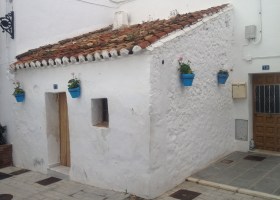
One of only a few remaining old houses in Mijas Pueblo
Goodness how quickly the winter months have gone by! It seems like a few hours ago that I returned to my “Costa del Sol” mountainside perch overlooking the Mediterranean Sea. In a few weeks I will be gone from the charming Mijas Pueblo. Over the two winters here I have become very aware that Mijas is a place that is tantalizing for the senses and that’s what this blog is about. I hope in reading this you will sense what I have and that Mijas Pueblo and the Costa del Sol will become new stops on your bucket list.
Burro Taxi in the streets of Mijas Pueblo
Recently I had lunch in the USA with a colleague. He pointed out that I have shared images and words about many of my Spain journeys to Granada, Ronda, Cordoba, and the Canary Islands but had documented my Mijas experience only in a limited way. So with this blog I share the sensations of the village I call “home” from having “wintered” here for the past two years.
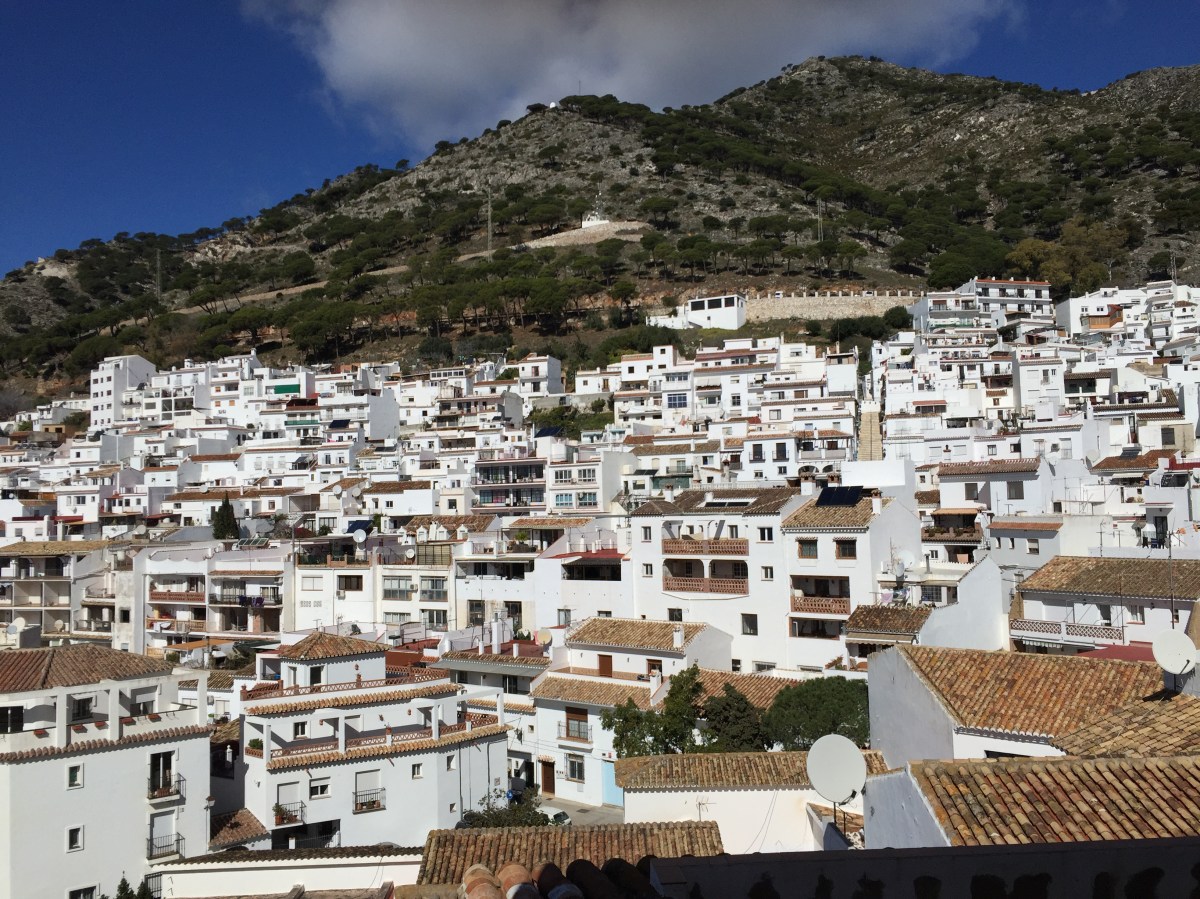
Mijas Pueblo is located on Spain’s southern Mediterranean Sea coast and the nearest city is Malaga, Picasso’s birthplace. Gibraltar is located about 70 kilometers further down the coast. The village buildings are almost always white and the town is situated 450 meters above sea level on the side of a 1600 meter mountain.
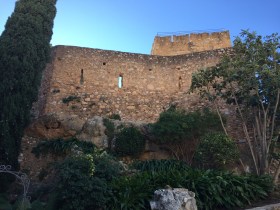
Remnants of the 14th century fortification in Mijas Pueblo
Remnants of ancient civilizations dating hundreds of years BC are evident along with artifacts from times when the area was dominated in succession by Romans, Visigoths and Moors. The village name is derived from the Roman name “Tamisa” which was shortened to “Mixa” and ultimately “Mijas.” Today, tourism is the principle economic resource of the community with thousands of people arriving everyday from every part of the world. In the oldest part of the pueblo stood a fortress and parish church that also served as a watchtower. Today, the church is still used but the original settlement area is now a park, the Parque La Muralla.
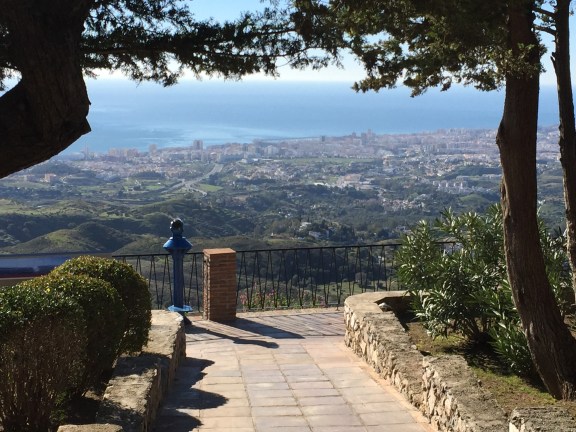
Fuengirola and the Mediterranean Sea from Parque La Mueralla in Mijas
Parque La Muralla is flooded with crisp mountain air and overlooks that provide spectacular panoramic views of Fuengirola and the Mediterranean coastline. On clear days the Rock of Gibraltar and the mountains in Morocco can be seen. Beautiful semi-tropical vegetation flourishes in the park and provides pleasant fragrances among the walkway paths and flowing water. Climbers often scale the rocks to the top where the park is located. I love this park as an excellent place to find stillness sitting on a rough rock seat and listen to the birds and running water. Even the tourists are mesmerized into silence by the stunning beauty and views found here.
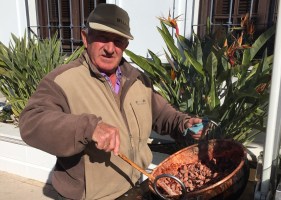
Mijas Pueblo street vendor roasting almonds
There are numerous visitor attractions in addition to the vistas, old white buildings, and roughness under one’s feet on cobblestone streets. “Burro taxis” have been in existence ever since tourists began to arrive in the village. At one time the “taxis” were a means to get around but today they are an attraction. Many people hold their noses around the burros but I find the donkey smell brings authenticity to this old community.
There are many other smells wafting through Mijas like fresh baked goods, street vendors roasting their almonds in a sweet sugar mixture, and delicious foods cooking at Gambas where the “menu” lunch on the hidden second floor terrace is only €7.25 including soup, bread, entree and wine!
A park fountain takes on a new dimension in the wind
Wind whips the flags outside Town Hall
The wind often howls through this community, stiffening the flags, and swaying their poles. Walking with the wind at your back is so forceful it makes you feel like a human sail! And when it rains on the mountain, water gushes through the ravines toward the sea. I have been thoroughly soaked in the drenching downpours. As storms and wind approach, the villagers lock themselves inside and the town vendors scramble to bring their pottery and leather wares to indoor safety.
Breakfast at Bella Vista
Mijas is thought to be home to around 7500. This seems like a high number as it includes many from the UK who either live in Mijas or own holiday property here. As I leave the town for my next exploration, I will miss many people. Steve and Brenda run the shop called “Tickled Pink” and they have tolerated my consulting pontification. They are very friendly folks and when you come to Mijas be sure to stop in.
Bruno operates “Bella Vista” and everyday makes my usual €3.70 breakfast called the “Andaluz” which is “pitufa con tomate, zumo de naranja, y cafe con leche.” It is a delicious natural treat found in this town. Fares Jaber at Clinica Mijas is the town doctor and has watched out for my well-being. He is my age and a new grandfather. He always stops me on the street to shake hands and to ask how I am doing. Joanne and David from “Mijas Rentals and Sales” have found places for me to stay in the village and have been great helpers even when I have locked myself out.
Burro
I will miss Mijas’ sounds… the rooster crowing daily at sunrise, the donkeys and their incessant screaming hee-haws, the small brass band from which sounds crisply spring over the pueblo during Sunday bullfights, bells jingling on horses clomping along pulling carriages transporting visitors through the streets, bells tolling from the three barrio churches, the town hall quarter-hour chimes, the sensual Spanish acoustic guitar player at La Alcazaba lunch (with exceptional lasagna and tapas), the sultry screaming guitar with clapping castanets at flamenco dance exhibits, and the butane delivery people honking their truck horns as they drive through the narrow, one-way village streets yelling out “bu tan oh” from the driver’s window.
I have enjoyed visiting “Mayan Monkey” for superb ice cream and hot chocolate made from real Belgian chocolate and I like dropping in on one of several bakeries for afternoon snacks and a tea or cafe latte. It has been nice living in Mijas, walking through the streets and being acknowledged by the villagers with warm greetings in Spanish which I return in Spanish too.
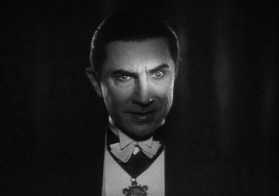
Dracula
I hope you enjoyed reading about my Mijas explorations and the impact on one’s senses. My next adventure on leaving Spain at the end of March will take me on a new exploration as I seek to learn more about Dracula and Vlad in Transylvania. I will travel to Budapest following my next trip from the USA and then journey by bus or train to Romania and the small city of Cluj-Napoca which will be my base through April. From there I will launch my next adventures and the new explorations with blogs to come about them.
In the 1970’s actor Ricardo Montalban was not only famous for staring in the TV series “Fantasy Island” but also as Chrysler’s celebrity spokesperson for marketing the Cordoba automobile. Who can ever forget his rich voice saying “soft Corinthian leather” when describing the car’s interior? Cordoba was “my car” although I never owned one. I did have high expectations for my explorations of Cordoba, Spain, linked by name although it is uncertain if Chrysler intended it to be so. Huge by today’s standards, in the ’70’s the Cordoba automobile was actually a “junior size” Chrysler! My excursion, however, was not a junior size at all; it was huge as I experienced another aspect of the culturally rich country of Spain.
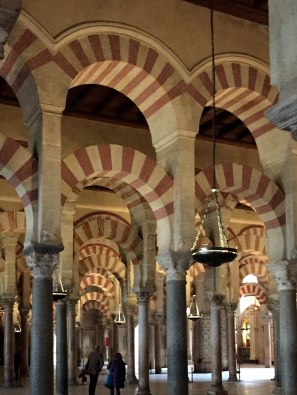
Interior of the Grand Mosque
Through the ages Cordoba has been everything from a small Roman outpost to the seat of power during the periods of Muslim occupation. Evidence has been found of humans in the area between 42,000 and 35,000 BC! An interesting fact is that Cordoba is believed to have been the most populous city in the world in the 10th century! Today, Cordoba is a small modern metropolis of about 300,000 and is protective of its Roman, Muslim, Jewish, and Christian heritage. That heritage loudly screams throughout the city, particularly in the area surrounding its famous UNESCO World Heritage Site mezquita (mosque) landmark as well as the Roman Bridge dating from the first century!
The city has witnessed numerous changes through the centuries which were driven by religious-based conflicts involving Christians and Muslims. In 1236 King Ferdinand III secured the city during the Spanish Reconquista. Since then numerous mosques were converted to churches including the huge one where the sanctuary was created in the middle of the existing mosque. The Christian era also brought about a dark period of the Spanish Inquisition with Cordoba at the epicenter. During this period non-Christians were treated as second class citizens with Jews and Muslims often forced to renounce their faith, leave, or die.
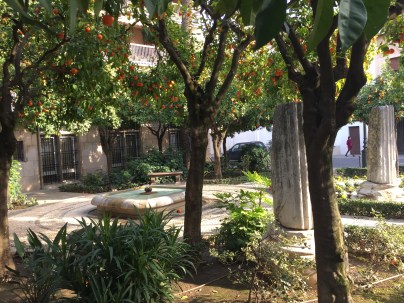
Peaceful Park in Cordoba
Walking through the narrow ancient streets one can celebrate the heritage where today Christians, Jews and Muslims live together in peace among the past Roman remnants of a beautiful city.
There are numerous parks throughout Cordoba like the one pictured that are quiet where you can pause, reflect and enjoy the simple sounds of water bubbling in the fountain. As in the pictured park, ancient pillars stand reminiscent of Roman times. Other parks are significantly larger and city planners appear to have gone to great lengths to incorporate them among the very wide avenues surrounding the ancient city walls.
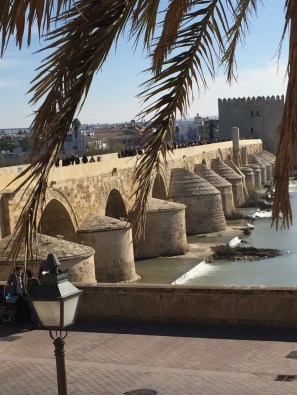
Roman Bridge
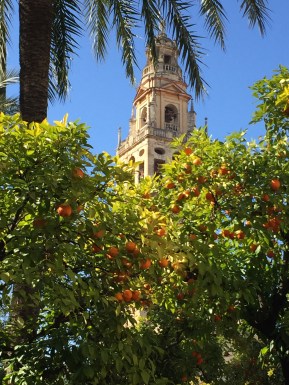
Most of my time during my exploration of Cordoba was inside the old city walls and remnants of them. Outdoor cafes are plentiful on the cobblestone streets among ancient buildings created mostly in the last 500 years. I was in awe walking across the preserved Roman Bridge and the cathedral where the bell tower stands among the orange trees and was constructed surrounding the original minaret.
I found the food and drink to be different from other places I have visited in Spain. There was often a blend of creations that reflected the cultures that I mentioned previously. I didn’t care for the local wine and found the famous cold, thick, tomato-based salmocejo soup to not be to my taste either. Regardless, there are plenty of different foods and drinks that more than provided very enjoyable sustenance!
Cathedral Bell Tower
Just like the Cordoba automobile of my youth, the city of Cordoba in Spain holds a special charm… one which is much longer lasting.
Cordoba is a beautiful modern city surrounding an old city with an outstanding Roman, Christian, Jewish and Muslim heritage. It is easy to see why this ancient place is preserved as a World Heritage Site for us and future generations to enjoy.
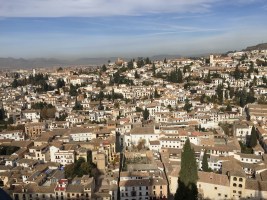
Situated below the massive, historic Alhambra in Granada rests the compact, densely populated, ancient district of Albayzin. Inhabited initially by Romans, some say that people have been in the area prior to the 7th century BC. I stayed in Albayzin, a World Heritage Site during my recent exploration of Granada and the Alhambra. My blog about the Alhambra is available by clicking here.
I knew I was in a place quite different in Albayzin when the taxi driver dropped me off at the top of a hill and pointed to narrow, cobblestone steps as the route to take to find the place I had booked. Going through the narrow walkways was like being on a scavenger hunt in a maze looking for the street and door number where the GPS and mobile phone didn’t function.
There is much debate about the origin of the name and spelling of “Albayzin.” It is, however, certain to have a Moor context. The guide at the Alhambra said that the inhabitants are often referred to as “the miserables”… not to be confused with other “miserables” of France. His explanation wasn’t exactly adequate that “people are just miserable there.” I never did find out why.
Walking Along the Darro River
Typical Walkway through Albayzin at Dusk
Typical Street with the Alhambra Looming
For this community there is a major influence and feeling reminiscent of the Moors. The buildings are hundreds of years old. The narrow cobblestone “streets” are almost always only wide enough for pedestrians. Going up and down the hills requires that one be sure footed, have a sturdy pair of shoes with excellent soles, and remain focused for ever present steps and the time-worn slippery stones.
At night, the walkways take on an eerie feeling even though they have been brightened by modern street lighting. One can imagine ages past when an unfriendly encounter might be waiting just around a dark building corner.
There are Numerous Flamenco Shows as Shown in the Poster
The Albayzin is small and exists on a hillside leading downward to the Darro River that runs between it and the hill on which the Alhambra sits. It is one of the oldest centers of Muslim culture in Granada and you can sense the cultural influences not only in the architectures but also in the food found in many modern restaurants where a flamenco show often comes with dinner.
Lunch at El Trillo
I ate at wonderful reasonably-priced restaurants in the Albayzin. At one particular meal the taste sensations created through expert use of herbs and spices were delightful as pictured… rice with chicken curry, shrimp, asparagus, greens, and slices of oranges. At another restaurant I ate scrambled eggs with potatoes topped with dried Iberian ham and at yet a third I delighted in eating a “fowl stew with raisins and nuts in a light dough.” I have never experienced foods like these.
The architecture in the Albayzin is distinctive where plain wooden doors in the district disappear and are replaced by works of art typical of many European cities as you leave it. The buildings outside the Albayzin take on a traditional Spanish feel and and statues commemorate famous events that have changed our world (click on the photo for a description).
Columbus Explaining His Proposal for Adventure to Queen Isabella
Modern Granada with its Wide Avenues
Doors are Works of Art
In the Alhambra there are water features everywhere reflecting the Moor past. There are fountains below the Alhambra but they tend to be massive while those developed by the Moors are much smaller in scale and simpler in design.
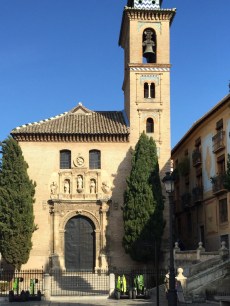
A Former Mosque Converted to be a Church
Just like in the Alhambra, each of Albayzin mosques that existed prior to the Christian monarchs’ “Reconquest of Spain” have been converted to Catholic churches like the one pictured. Note the bell tower was erected atop the mosque’s minaret.
On exiting the Albayzin area there are many tourist shops, coffee shops and places where young people hang out. These are mostly nonexistent in the Albayzin.
Overall, Granada with the spectacular Alhambra, Generalife, and Albayzin provide a rich Moorish past that is ever present even after 500 years following the Reconquest by Ferdinand and Isabella. In the city there is a complimentary blending of the Moor and Spanish cultures which makes Granada really special for me and very enjoyable for every visitor!
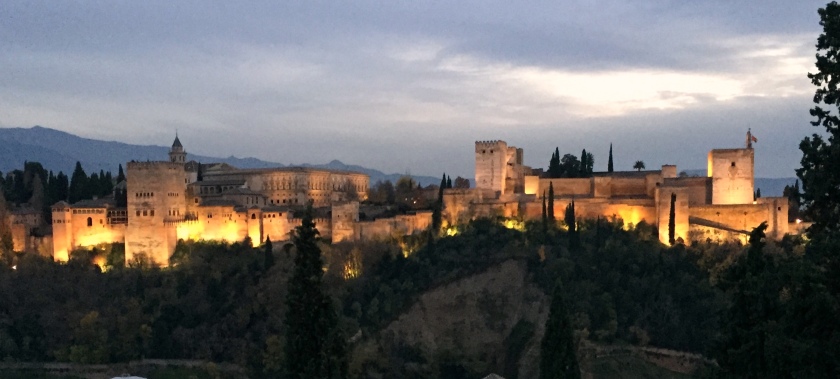
Towering over the city of Granada sits the spectacular Alhambra, a once great, self contained, red-walled city with palaces, mosques, and homes. With construction by the Moors beginning in the 9th century, the Alhambra (derived from Arabic meaning the “Red One”) overlooks the Albayzin, a World Heritage Site and the oldest part of Granada. The Alhambra has evolved through the centuries from its original Acazaba fortress (the right side of my photo) to be a seat of Iberian ruling power and authority for Muslim sultans and emirs and Spanish Christian kings and queens.
The Alhambra at Dusk
Today the Alhambra is Granada’s jewel with an average of 10,000 visitors every day. This World Heritage Site has seen numerous notables come and go as well as physical changes over the centuries. In many cases, we can only imagine the Moor’s mosques, schools, houses, baths, gardens, and government buildings. Many structures have disappeared from neglect, war, vandalism, or, as in the case of the mosque, replaced by other buildings such as the Catholic church and another Palace built by Carlos V.
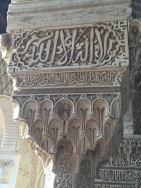
Column Inscription at Generalife Palace
Following the conclusion of the “Reconquest of Spain” from the Moors in 1492, Queen Isabella and King Ferdinand set up a residence at the Alhambra. In the same year Columbus came to the Alhambra to seek financial support for his adventures which was eventually granted as we all know. Napoleon had soldiers quartered within the Alhambra city walls during the Spanish War of Independence. As the troops withdrew in 1812 they blew up several structures thus destroying an important part of the world’s heritage.
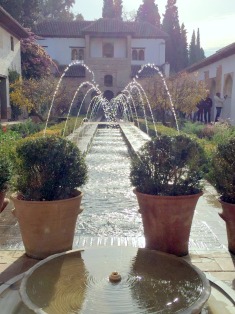
Water Flows Naturally Through Man-made Fountains and Pools in Alhambra and Generalife
The rich Alhambra architecture combines Moorish and Renaissance Spanish with numerous water features and gardens that have been preserved and meticulously restored. The emirs even had their summer palace and rural getaway estate and gardens called “Generalife” which means “Architect’s Garden.” Generalife is adjacent to and outside the Alhambra city walls. It also is a World Heritage Site with its picturesque small park with trees, gardens and several man-made water features on the grounds of a simple-looking palace with many ornate interior wall decorations.
While walking through the grounds I could see how their construction met its objective for providing a calming place for the rulers to relax and unwind from their responsibilities. The park has several very old trees as well as newer plantings which was intended so the park would forever evolve. In the summer vegetables are grown in the Generalife.
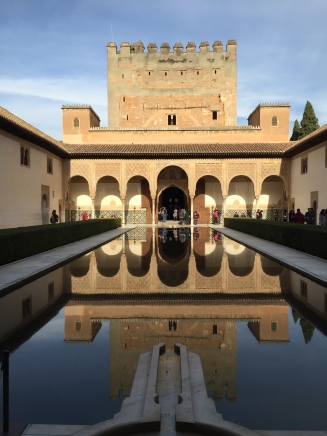
The Throne Room is at the Far End of this Reflective Pool Inside the Alhambra Palace
In addition to Generalife, the nature themes of plants, water features, and gardens are inside the Alhambra also. All of the water flows naturally through a system of small aqueducts that bring fresh water from the nearby mountains. Water features are everywhere and are important to the Muslims. The plants and trees inside the Alhambra are meticulously maintained. Water is always in the center of each building in courtyards except for those built by the Christians.
In 1492 when the Moors surrendered following a siege of the Alhambra, Ferdinand and Isabella moved into the Alhambra as a residence. Where the sultan once held court, the Spanish monarchs then did in the same room.
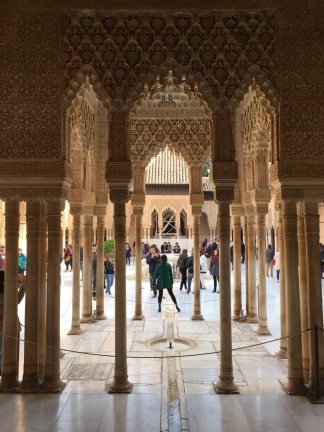
The Palace Residence Entrance is Stunning
The entrance into the residential area of the palace is very ornate. The sultan’s palace rooms are jaw-dropping beautiful as are his “first wife’s” rooms. The sultan’s “first wife” is not numerically determined by marriage date but rather the first with whom he has a male heir. A courtyard with an interesting fountain is between the sultan’s suite and the first wife’s suite. The fountain was given to the sultan 700 years ago by a local Jew and represents the tribes of Israel. The tour guide said that in past ages the relationships between Jews and Muslims were much different than today.
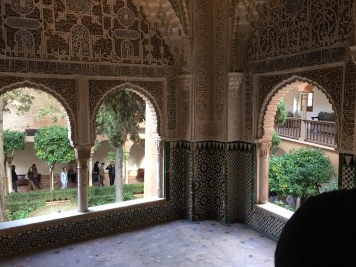
A “First Wife” Room and View
Views of nature are present from each room in the palace. There are numerous walkways through gardens and water features are everywhere. The existing grounds are quite special today and one can imagine what they were like when the Alhambra was a bustling city.
My exploration of the Alhambra was exceptional and there is so much more to see here. Things we learned in school are only a very small part of the exciting (and often sad) history of Spain and the influence that past has for us today. In my blog about the Albayzin district (click here) I describe my exploration of Granada outside of the Alhambra walls where history there also impacts our American way of life.
Here are a few additional photos that I hope you enjoy. The photos are the church built over the Muslim mosque, the ceiling in the sutan’s residence, a walkway through the Generalife retreat, the fountain given to the sultan representing the Tribes of Israel, and the entrance to the Alcazaba fortress.
 I have now been in Cluj-Napoca, Romania for almost a month and I have made many observations while exploring this small city. This entry into my travel blog is about my observations during my exploration of Cluj.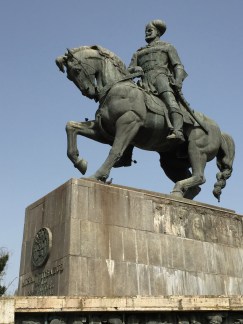












 Barry's Adventures Following Retirement